
Trust across the Supply Chain
Today’s customers, regulators, and business partners expect more than promises. They expect proof.
That’s why chain of custody has become a board-level issue across manufacturing, healthcare, industrial gases, logistics, and other asset-intensive industries.
What Is Chain of Custody?
Chain of custody is a verified record of where an asset has been, who had possession of it, and when each transfer occurred.
It creates a trusted history for every product or asset from production to delivery.
Without it, companies depend on manual records, spreadsheets, and human processes that can leave gaps, increase risk, and make audits more difficult.
Why Executives Are Paying Attention
A strong chain of custody helps organizations:
- Reduce compliance and audit risk
- Protect revenue from counterfeit or unauthorized products
- Strengthening customer trust through transparency
- Improve accountability across the supply chain
- Resolve disputes with verifiable data instead of assumptions
In many industries, the ability to prove what happened is becoming just as important as what happened.
Chain of Custody vs. Inventory Tracking
Many organizations know how many assets they have.
Far fewer can prove the complete history of a specific asset.
Inventory tracking answers:
“How many do we have?”
Chain of custody answers:
“Where has this specific asset been, and who was responsible for it?”
That difference becomes critical during audits, recalls, customer disputes, or compliance reviews.
What Makes a Reliable Chain of Custody?
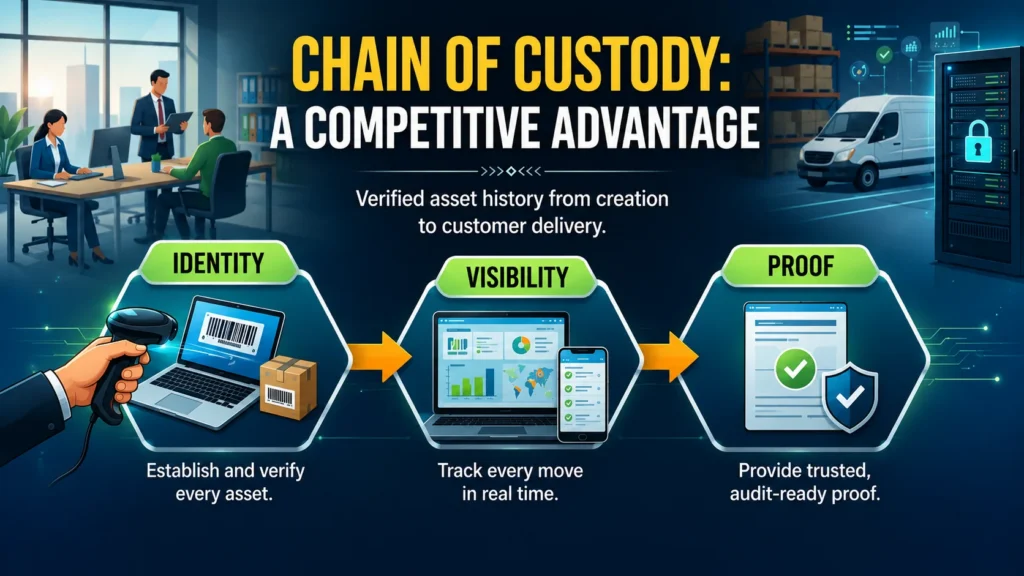
Three elements are essential:
- A unique identity for every asset
- Automatic capture of every handoff or movement
- A permanent, auditable record that cannot be easily altered
When these elements work together, organizations gain real-time visibility instead of relying on reconstruction after an issue occurs.
Where It Delivers the Greatest Value
Chain of custody is especially important for:
- Industrial and medical gas cylinders
- Healthcare and regulated environments
- Food and cold-chain logistics
- Returnable assets such as pallets, totes, and kegs
- High-value products vulnerable to diversion or counterfeiting
In these industries, a missing link in the record can create compliance exposure, lost revenue, or customer trust issues.
The Business Case
The future of asset management is not simply knowing where assets are.
It’s being able to prove their history with confidence.
Organizations that establish a verifiable chain of custody gain stronger compliance, better operational control, and greater trust with customers and partners.
In a market where proof increasingly matters more than process, an unbroken chain of custody becomes a competitive advantage.
Read time: <2 minutes