U
Usability
Usability is the action layer of IVU. AI-embedded workflows guide each step, check it before it moves on, enforce SOPs and compliance, and write the audit trail automatically. New hires perform like trained ones in days. Data integrity and governance are properties of the process, not paperwork.
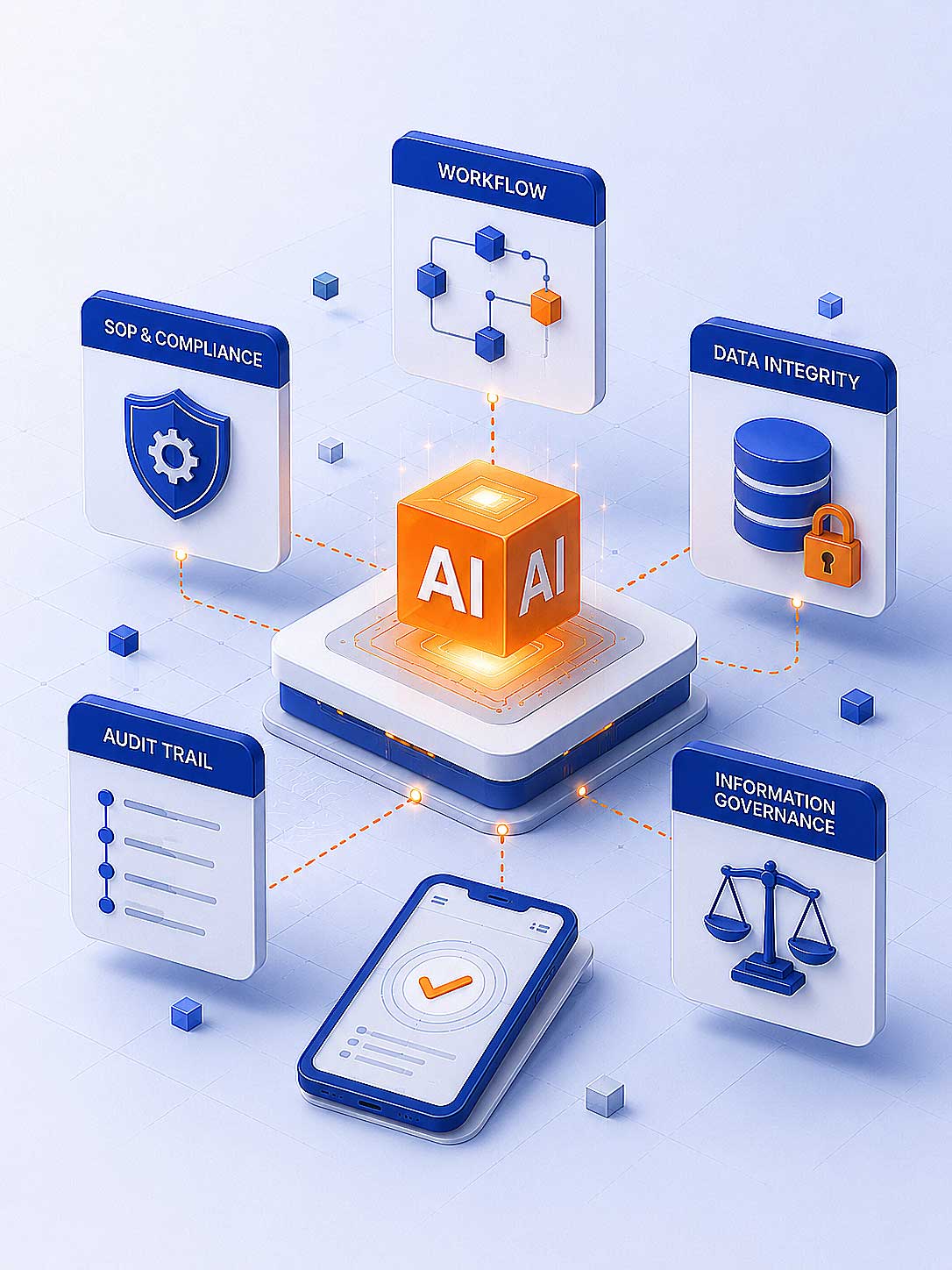
A binder full of SOPs no one reads is not usability. A dashboard no one logs into is not usability. Usability is what happens when the right step, the right rule, and the right record are baked into the work itself, not bolted on the side.
01 / SOPs IN-LINE
Guidance at the point of use.
Each step appears on screen, in the worker's language, with a check. The next step does not unlock until the current one is right.
02 / COMPLIANCE BY DESIGN
Rules enforced, not remembered.
Safety, quality, labor, customs, and environmental rules sit inside the workflow. Audit trails write themselves.
03 / DATA INTEGRITY
Capture at source. Lock on post.
Data captured automatically at the point of use. No back-dating. Closed by date. Records cannot drift.
04 / SMART ESCALATION
Hard cases to the right human.
When something is genuinely tricky, AI hands it to the right supervisor or engineer with full context. No guessing.
Executive Summary
Identity tells you what an asset is. Visibility tells you where it is. Neither of those, on its own, decides whether the right thing happens next. That is what Usability does. It takes truth, Identity, and the live picture, Visibility, and turns them into correct, compliant, audit-ready action.
For decades, the answer to how do we make sure work gets done right was a binder full of SOPs, a senior worker walking the line, and a stack of paper checks that someone eventually typed into a system. It worked, slowly, when staff stayed long enough to learn. Today, workers move on faster. Compliance rules grow heavier. Margins are thinner. The old answer no longer fits.
That is the shift. From SOPs you have to remember, to SOPs the system enforces. From compliance you have to chase, to compliance baked into the work. From manual data entry with a 20% error rate, to point-of-use capture with no human in the loop. From audit-week panic, to an audit trail that writes itself every minute of every day.
This is why Usability sits at the end of the IVU framework, not because it is least, but because it is what everything else is for. Identity and Visibility give you the data. Usability is the part where the data finally pays you back: fewer errors, faster ramp-up, cleaner audits, lower waste, and a workforce that performs above its years of experience because the process itself does the heavy lifting.
Usability is not one feature. It is a stack of four engineered properties that turn raw visibility into trusted action. Here is what each layer does, and why it matters.
Layer 01
S
OPs IN-LINE
The procedure becomes the process.
Embedded AI delivers the next correct step on screen, in the worker's language, with a picture or short video where useful. The current step has a check: the right asset ID was scanned, the right valve was selected, the right test date was confirmed. The next step does not unlock until the current one is right.
• In-language guidance: SOPs delivered in the worker's first language, on the device they already use.
• Real-time checks: wrong scan, wrong input, wrong sequence — caught before it reaches the next stage.
• Process validations: hundreds of built-in confirmations of data-pool status before each step.
• No paper: the SOP binder becomes a property of the system, not a document on a shelf.
Layer 02
C
OMPLIANCE BY DESIGN
The right thing and the easy thing become the same thing.
Compliance breaks companies in two ways. The big way: a fine, a recall, a lost license. The small way: hours of staff time every week filling forms and chasing approvals that add nothing to the product. Embedded AI fixes both. Rules sit inside the workflow. The system blocks actions that would break a rule. The audit trail writes itself.
• Safety: safety checks must pass before the next step unlocks. Out-of-test assets cannot enter production.
• Quality: defects spotted in real time, pulled before they travel down the line.
• Labor & hours: shift, break, and overtime rules enforced against local law, with warnings before violation.
• Customs & trade: export forms self-fill, restricted-party lists self-check.
• Environmental: energy, water, waste limits monitored with alerts before a regulator notices.
• Audit trail: every action and override logged automatically. Audits become a query, not a project.
Layer 03
D
ATA INTEGRITY
Captured at source. Locked on post. Closed by date.
Manual data entry, pen to paper to keyboard, carries roughly 20% error. Those errors compound. If you cannot trust your data, neither can your customer or your distributor. Usability fixes the integrity problem at the moment of capture and keeps it fixed through governance built into the workflow.
• Point-of-use capture: RFID + AI capture data where the work happens. No transcription, no typing.
• Posted records cannot change: once a record is posted, it is locked. No silent edits.
• No back-dating: data entry is closed by date. Inventories and outstanding-item reports stay accurate.
• Good Manufacturing Practice: GMP and information governance baked into every step.
• Near 100% accuracy: automated capture replaces 20%-error manual entry.
Layer 04
S
MART ESCALATION
Humans on the big calls. AI on the rest.
Embedded AI does not replace workers. It replaces the parts of the job that should never have needed a human in the first place: the typing, the form-chasing, the rule-remembering. When something is genuinely tricky, the system hands it to the right person with the full context already attached. The new worker is never stuck guessing.
• Tricky cases routed: the system knows who owns each exception type and contacts them directly.
• Full context attached: asset history, current state, the failing rule, the worker's last actions — all included.
• Days, not months: new hires reach trained-worker output quickly because the system carries the institutional knowledge.
• Turnover hurts less: when the process holds the expertise, losing a senior worker is not catastrophic.
Compliance by design means the rule sits inside the workflow, not in a binder. Here is how embedded AI delivers it across the six compliance areas that hit operators hardest.
When SOPs, compliance, integrity, and escalation are baked into the work itself, the gains compound on output, errors, training time, and audit readiness.
Days
to ramp up new hires (vs. months)
~100%
data-acquisition accuracy at point of use
8-15%
energy bill reduction with AI controls
10x
cheaper to catch defects on-line vs. at final inspection
Common Questions
We will map your current SOPs, the compliance load you carry, and the points where data integrity is leaking. Then we will propose a 30-to-60-day proof of concept built around one painful workflow, the one where the win pays for the rest.
